
Join Schrödinger’s Chat
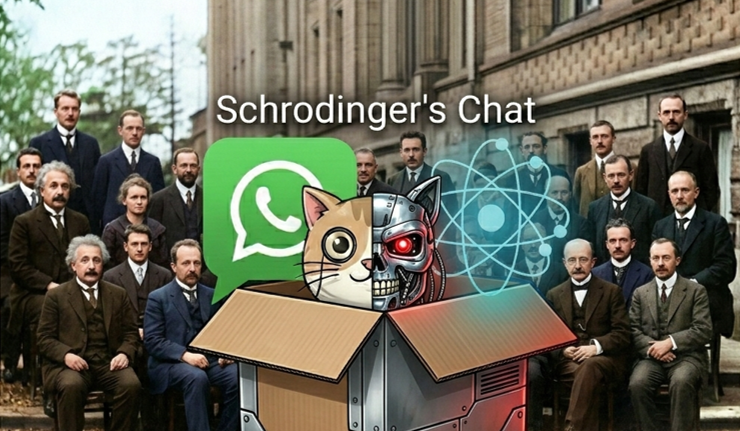
Schrodinger’s Chat is an active community of over 350 Physics teachers and technicians on WhatsApp, who like to help each other by sharing ideas and resources. Sometimes we even make an attempt at being humorous.
Its origins were as the original Isaac Physics WhatsApp group, but once the official group was developed (some politics over ownership), we democratically changed our name and declared independence.
I host the shared google-drive, and have plans to compile the wisdom of the crowd into these webpages, but it will take me some time, so please be patient. As a stop-gap, I’ll start by sharing some of my favourite hand-crafted resources and point you in the direction of lots of other great online resources.
Hopefully, these pages will grow to become a real life-saver for teachers everywhere, particularly if you’re new to the profession or struggling as a solo physicist in your school!
You can request approval to the WhatsApp community here and then will be able to request direct access to the shared google drive. We just ask that you also share your best resource with the community in time.
Here are a couple of example of resources I’ve uploaded that I have used to great success:
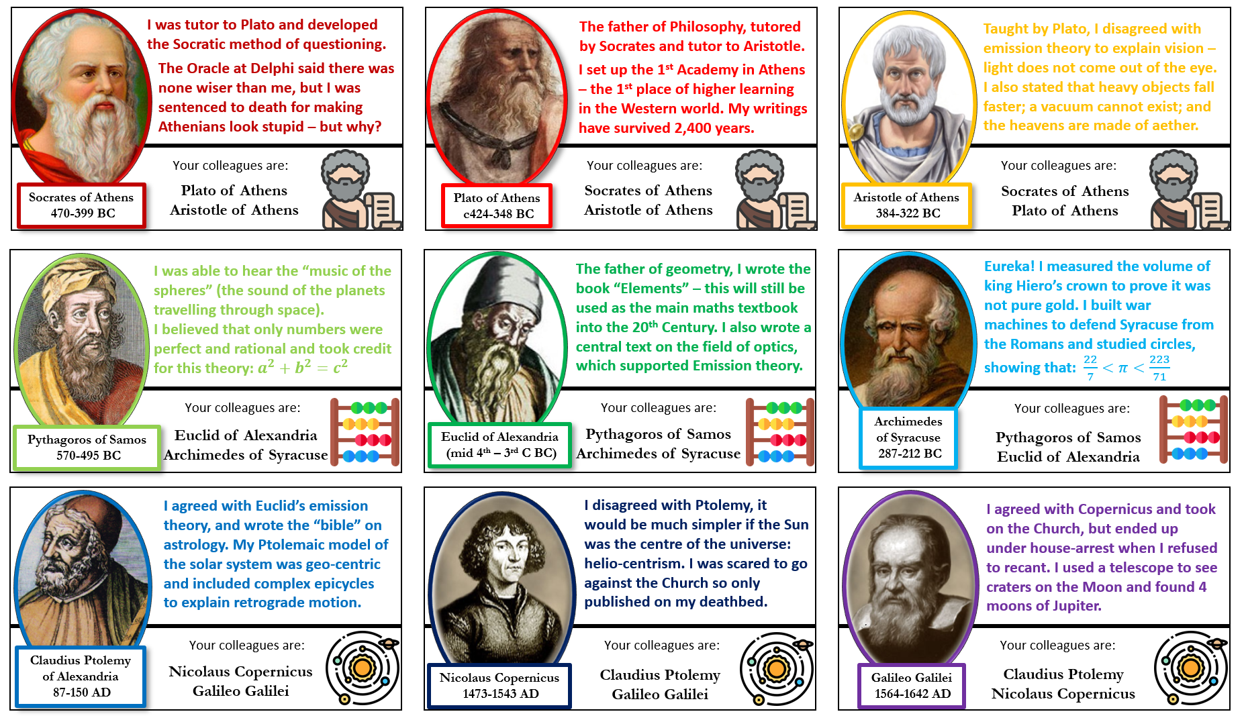
Lab Partner Cards (History of Science)
You may have noticed that a passion project of mine is the History of Science. I saw someone selling a pack of cards used to determine how groups were formed for class practical or activities and was inspired to make something better and sell it for FREE! A few days later and I had crafted 18 sets of trios, each of whom made a significant contribution to a particular field or discovery. Download, print on glossy paper and cut out so you can use them again and again – just make sure the students don’t crease them.
How I use them:
Decide how many pairs or trios you want for a particular practical and deal out that many cards from the set. Hint: Do this after taking the register. As students are reading through the practical instructions they’ll each pick a card at random from the deck. They then have 3 minutes to find their partner(s), introduce themselves in character, learn how they were important to science and then pick a desk to work on the practical together!
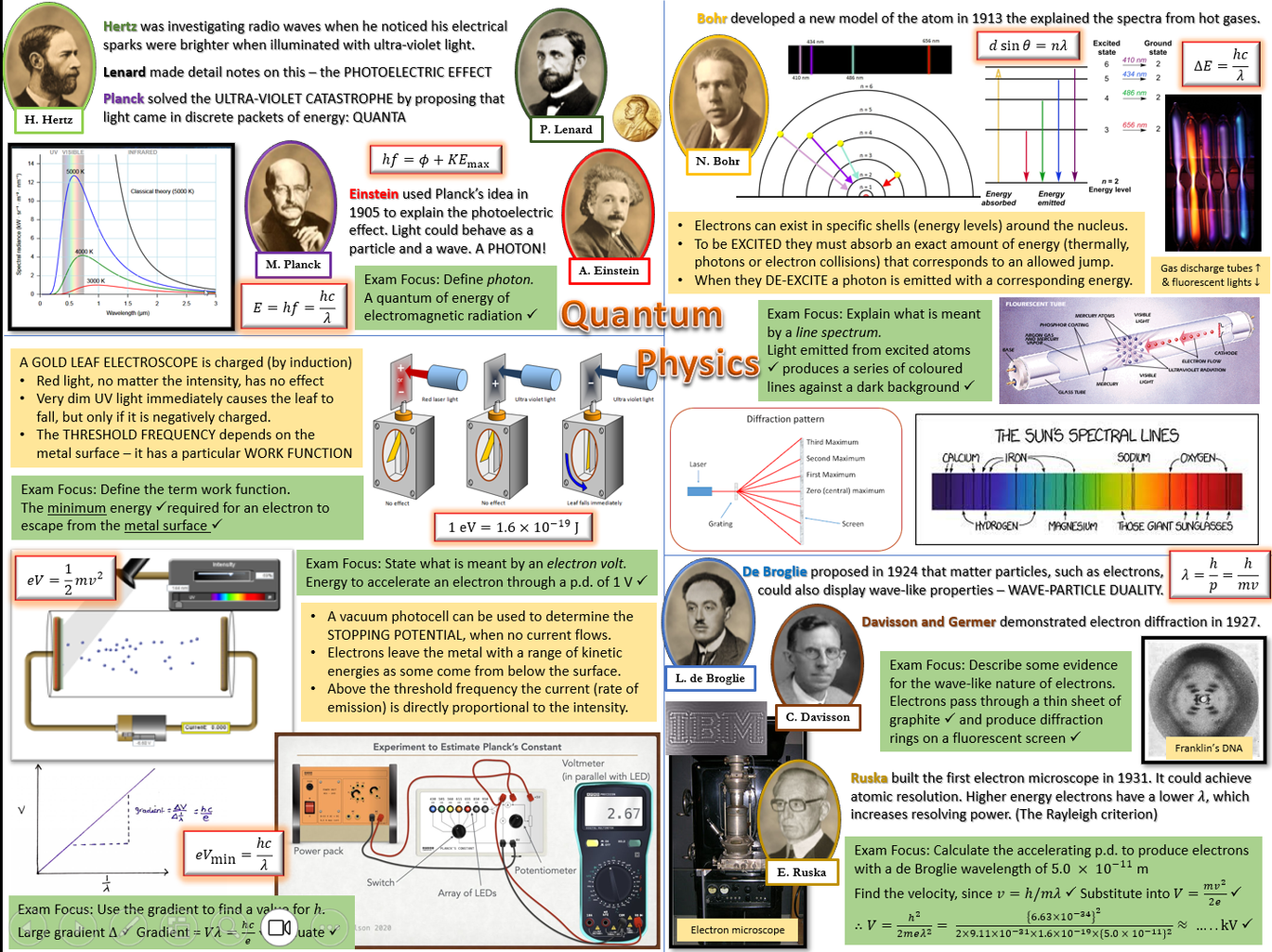
Revision Poster (Quantum Physics)
One of the most effective ways of learning a topic is to consolidate the content and actively make links between the sections. I find posters very effective, and making them colourful and engaging means you can happily spend 5 minutes a week reviewing them.
How I use them:
Model the process of making them during a 2-hour revision lesson, start by cropping the specification into a powerpoint, finding images online, then text boxes and equations. Once you’ve got all the content, rearrange to it’s logical and pretty. As a final iteration, if you’ve done past papers and spot repeated questions, add these as the “exam focus” boxes.
My favourite simulation sites
Nothing quite beats a real-life class demonstration, except when the demonstration goes wrong or doesn’t actually show you what you need to understand (aka electricity). That’s why you’ll need an arsenal of great simulations, not just as a back-up, but for your front line teaching!
1. PhET (Maths & Science)
2. VP Lab
Your content goes here. Edit or remove this text inline or in the module Content settings. You can also style every aspect of this content in the module Design settings and even apply custom CSS to this text in the module Advanced settings.
3. Science Games
For electricity I always use Crack The Circuit and recommend Wired as a fun extension activity. A whole library of educational games can be found here
4. Ophysics
Ophysics has a growing collection of physics simulations mostly using GeoGebra
5. Dr Dan Jones' Apps
Dr Jones (aka Hookean) has lots of demos on youtube and has harnassed the power of AI to make a load of simulations here
My favourite content websites
I’m not going to re-invent the wheel here, many came before me and are freely sharing their hard work, so the definitely deserve a shout-out from me…
1. Physics Online (KS4 & 5)
When I was new to teaching, Lewis’ videos were a godsend and helped to buy me time on numerous occasions. His online empire continues to grow and I’d encourage anyone to lobby for a school subscription to his platform(s).
2. Hyper Physics
If you want to learn something properly, so that you seem knowledgeable to your students, this is my first stop. It’s mostly at undergraduate level and they don’t shy away from the maths. I also like the mindmap that shows how all the topics are linked. For example, here’s an overview of Electricity and Magnetism
3. Paul Hewitt's Next Time Questions
These are beautiful cartoons, each of which addresses a particular concept or common misconception. Most of the time the “obvious” answer is not correct. The idea is to end the lesson with the question, give the students time to ponder it and then discuss it in the next lesson. Check them out here.
4. CGP Books
Did you know that teachers can get 3 free samples each year – I’ve amassed quite a library of textbooks, revision guides, workbooks and flashcards. Many come with a licence to an online version for 3 years.
My favourite learning websites
The only reason I survived 12+ years in classroom teaching was because at least two-thirds of the homework tasks I set were essentially “fire and forget”. This freed up my time to plan engaging lessons and focus my marking feedback effectively.
1. Isaac Science
I’ve seen this project grow from it’s embryonic stage while I was doing my PGCE in Cambridge, and the amount of freely available questions, with instant feedback, hints and support is staggering. I’ve done around 12,000 question parts and doubt I’m half-way through. It’s an absolute game-changer, but I’m still coming across schools who haven’t heard of it. I regularly make the pilgrimage to the motherland for their teacher jolly.
2. Seneca Learning
Reading a textbook isn’t a great way to retain information, but it is a necessary first step to learning new concepts. Seneca essentially brings the textbook to life with memes and video clips, but it asks lots of questions as you go to make sure you’re taking in the information. It also allows teachers to track students progress and how much time they’ve spent using it.
3. Exam Smasher
Check out exam smasher, it’s great for independently practicing 10 multiple choice exam questions before breakfast, or as starter/extension activity or a 20 minute blast in a revision lesson.
4. Physics & Maths Tutor
No longer just for Physics & Maths, a go to site for easily finding past papers, markschemes and examiner reports all in one place.
You can even select exam questions by topic rather than whole year – very useful revision for mid-term assessments.
My favourite places for Admissions Test preparation
Top universities are finding it harded to select based on grades and personal statement alone. Many will require admission tests and/or interview. It’ll be necessary to look beyond past papers…
1. BPhO
No longer just for Y11 and upwards, there are introductory competitions for KS3 students. These are always a great stepping stone towards proper problem solving. Check out the competitions calendar here and practice the year 12 past papers
2. Preparing for Oxford Physics
Replacing the Preparing for the PAT course, I’ve re-written the new course run by Oxford University with lots of problem solving tips and devious problems to solve. Check out the resources here and be sure the Y12 students register before it starts each year in June
3. UAT UK
You’ll need to register here if you’re going to take the ESAT or TMUA, but you can browse through the archive of past papers freely and take the specimen tests.
4. STEM Smart
Some of the problems on Isaac Science give me nightmares, and if you’d like to be guided through the weeds by people at the University of Cambridge, this is a very useful long-term programme for new year 12 students to sign up to in September / October
5. UCL Placement Tests
Here’s some multiple choice questions you can use similar to the ESAT from UCL
My favourite school competitions
If you’ve got a budget or grant to set up a new club then that’s great news. If funds are tight then looking to fundraise or for sponsors is often a part of these competitions too.
1. STEM Racing
Formerly F1 in Schools, teams of up to 6 students compete in either development or pro classes to design and build CO_2 powered mini-F1 cars.
2. First Tech Challenge
If you want to do something with Robotics, this is probably it – you can have 15 in a team with a variety of roles to fill. You’ll want to secure funding to get all the equipment in the first year.
3. Safe Cracking Challenge (Y12)
Teams of up to 5 year 12 physics students build a safe that is locked by 2 physics mechanisms. At competition day (usually in Dulwich), they have 10 minutes to try to crack another team’s safe.
4. IET Faraday Challenge Days (Y8)
Aimed at teams of 6 12-13 year olds, these are a great one day challenge with limited preparation needed. You can run it yourself or have someone come in and you just need to provide the venue – teams could be all from your school or for real competition, get your neighbouring schools involved too!
5. UK Rocketry Competition
If you like the idea of trying to send an egg safely up a certain distance in a certain time-frame in a rocket of a certain weight and have it return safely back to Earth, then the UK Rocketry competition is probably what you’re looking for.
Depending on how many explosive test flights you’re going to have, £500 seed funding could get this off the ground.
6. IET First Lego League
It used to be EV3 Lego Mindstorms, but they now use the SPIKE Lego. If you’ve got (or are getting) any of these kits already in school then it’s relatively cheap to enter the First Lego League each year (second team often half price)
My favourite school visits/trips (outside of London)
If you’re looking for somewhere to get away for a day trip or residential, consider these.
1. European Space Center, Belgium
I’ve* done 2 large multi-school trips here for around £650 per head for 4 days and 3 nights. We were accommodated on-site at ESC we also had excursions to Bouillon Castle and the Caves of Han
*Tour operator Visions in Education helped with these – I also went on their FREE teacher exploratory visit twice, which happens in January each year.
2. National Space Centre, Leicester
Open daily from 10am – 4pm, you could potentially fill 6 hours with a planetarium show, talks, workshops and exploring the various galaries. I’ve managed to do a 3-hour day there before, but that was travelling from London
3. Physics @ Work, Cambridge (FREE)
Every September the Cavendish opens its doors to various exhibitors and school groups. In a morning or afternoon slot you’ll see 6 random exhibitors. I find Y11-12 students are best suited to the content, and I usually find a link college to host us for the other half-day.
If you travel with another school you may also be eligible for a travel bursary or even over-night accommodation if travelling from afar

Hello world!
Welcome to WordPress. This is your first post. Edit or delete it, then start writing!
 English
  Spanish