
Topic
Motion
For 2000 years, most people mindlessly believed the teachings of Aristotle, but do heavy objects really fall faster? Is the Earth really the centre of the Universe? Archimedes devised a method to move the Earth, if only he could find a pivot, but it wasn’t until 1609 that Galileo turned the world on its head by turning his telescope to the moons (ours and Jupiter’s) and paved the way for Newton to define the laws that would see mankind set foot on the Moon 300 years later.
Key Motion Concepts
Distance & Speed
Displacement & Velocity
Equations of Motion
Projectile Motion
Why Motion Matters
in Physics
Motion is one of the most fundamental areas of physics, forming the basis for understanding mechanics and dynamics. By studying how objects move, students develop the ability to predict, calculate, and explain physical behavior across a wide range of contexts.
This unit also emphasizes the use of graphs and equations to represent motion, helping learners visualize changes over time. With these skills, students can confidently approach exam questions and apply physics principles to everyday phenomena.


Distance and speed
Do you ever wonder how your SAT NAV is able to predict what time you’ll arrive at your destination? It will need to take into account the expected traffic (and weather) conditions along your journey, and know of any road works or temporary speed limits, perhaps due to accidents. It’s tremendously clever, but at a first approximation, if you know the distance and the average speed you’ll be travelling at, then the time is simply the total distance divided by the total time.
This equation is so fundamental you should probably commit it to memory, and yet I don’t – I just remember the fact that speed is measured in m/s (or mph) and think about the units to re-derive the equation each time. That skill is far more valuable than regurgitation – try it!
Lewis Matheson has taken the specification and turned it into a bite-size student-friendly format. I recommend printing this out and having a learning checklist at the start of your folder for each section:
OCR A – module 3 – forces and motion
AQA – module 4 – mechanics and materials
Sign up for a free account to Isaac Science and it’ll save and track your progress – working through these problems is necessary to secure that 30-40% of the paper that will be mathsy.
GCSE Ch2.8: Speed, distance and time
GCSE Ch2.8Add: Additional speed, distance and time
Here you can practice reading some of the key measuring instruments:
I think these are fab, and hopefully your school has a subscription to them.
342: Preparing for A Level Physics – Motion
See below for a quick selection of the relevant videos, you can find Lewis’ full playlist for motion here.
Displacement and velocity
Do you ever feel like you’re going around in circles but never getting anywhere? Well then you’re thinking about your displacement. If you end up back where you started then your displacement is zero. Although that’s not entirely true, it’s also a vector, so you’ll have to specify which direction to travel zero distance in, so good luck with that!
If running around in circles gets you in a sweat and you’re feeling out of breath, then you must care about the distance that you’ve actually travelled. This could be called exercise and helps to depreciate the value of my car as it records how many miles I have travelled in total, not just how far away it is from the dealership it was bought from.
Now you know the difference, that’s pretty much all there is to it, except for the fact that most of the time we’ll be using displacement we’ll not really care about the direction, or we’ll maybe add a +/- sign to pretend it matters.
Lewis Matheson has taken the specification and turned it into a bite-size student-friendly format. I recommend printing this out and having a learning checklist at the start of your folder for each section:
OCR A – module 3 – forces and motion
AQA – module 4 – mechanics and materials
Sign up for a free account to Isaac Science and it’ll save and track your progress – working through these problems is necessary to secure that 30-40% of the paper that will be mathsy.
GCSE Ch2.9: Displacement and distance
Here you can practice reading some of the key measuring instruments:
I think these are fab, and hopefully your school has a subscription to them.
See below for a quick selection of the relevant videos, you can find Lewis’ full playlist for motion here.
Acceleration
There are two things you need to know about acceleration…
1. It is the rate of change of velocity: a = (v-u)/t
2. It is the effect a resultant force has on a mass: F = ma
Understand and apply those steps and you’ll have the keys to unlock most of the questions that A-levels will throw at you. Mathematically you can write acceleration as the second time-derivative of displacement, but did you know the third derivitative is called “jerk” and the next are “snap”, “crackle”, and “pop”, because physicists think they’re funny. I of course agree, because I’m a physicist.
2.1.1 Linear Motion
Lewis Matheson has taken the specification and turned it into a bite-size student-friendly format. I recommend printing this out and having a learning checklist at the start of your folder for each section:
OCR A – module 3 – forces and motion
AQA – module 4 – mechanics and materials
Sign up for a free account to Isaac Science and it’ll save and track your progress – working through these problems is necessary to secure that 30-40% of the paper that will be mathsy.
GCSE Ch2.11: Acceleration
Here’s a useful tool from oPhysics:
I think these are fab, and hopefully your school has a subscription to them.
See below for a quick selection of the relevant videos, you can find Lewis’ full playlist for motion here.
Velocity-time graphs
Velocity-time graphs are probably the best way to understand motion and actually picture what’s happened during a journey. The take home messages are that…
1. It’s gradient corresponds to the acceleration.
2. The area beneath the curve and the x-axis corresponds to the displacement.
Understanding this and a bit of simple geometry will enable you to derive 4 of the SUVAT equations from a simple graph and it’ll all make perfect sense. If you wanted to complete the set, you can just combine two of those equations to eliminate time.
2.1.2 Graphs of Motion
Lewis Matheson has taken the specification and turned it into a bite-size student-friendly format. I recommend printing this out and having a learning checklist at the start of your folder for each section:
OCR A – module 3 – forces and motion
AQA – module 4 – mechanics and materials
Sign up for a free account to Isaac Science and it’ll save and track your progress – working through these problems is necessary to secure that 30-40% of the paper that will be mathsy.
GCSE Ch2.10: Motion Graphs: Displacement-Time
GCSE Ch2.12: Motion Graphs: Velocity-Time
Here’s a useful tool from oPhysics:
I think these are fab, and hopefully your school has a subscription to them.
052: Displacement-time and velocity-time graphs
120: Interpreting and drawing graphs of motion
See below for a quick selection of the relevant videos, you can find Lewis’ full playlist for motion here.
Equations of motion
I don’t know why we use s for displacement, but I guess DUVAT didn’t have that ring to it. u is the initial velocity and everything else seems sensible… v is the final velocity, a is the acceleration and t is the time. Use these enough that they become muscle memory:
v = u + at
s = ut + (at^2)/2
s = vt – (at^2)/2
s = (u+v)t/2
v^2 = u^2 + 2as
Now multiply that last one by m/2 and what do you notice?
Lewis Matheson has taken the specification and turned it into a bite-size student-friendly format. I recommend printing this out and having a learning checklist at the start of your folder for each section:
OCR A – module 3 – forces and motion
AQA – module 4 – mechanics and materials
Sign up for a free account to Isaac Science and it’ll save and track your progress – working through these problems is necessary to secure that 30-40% of the paper that will be mathsy.
B3: Uniform Accelerated Motion in 1D
Here’s a useful tool from oPhysics:
I think these are fab, and hopefully your school has a subscription to them.
013: Motion I
072: Why students lose marks: AS motion questions
See below for a quick selection of the relevant videos, you can find Lewis’ full playlist for motion here.
Stopping distances
If you’re learning to drive you’ll need to know the theory of maintaining a safe driving distance to pass the theory test… “only a fool disobeys the two second rule!” is probably more useful than the chevrons painted a set distance apart on some motorways. The safe stopping distance, which is made up of thinking distance + braking distance depends on yours speed and so many other factors.
Once you are driving around you’ll no doubt get frustrated by variable speed limits, but sometimes lowering the speed limit actually means you’ll move through a traffic jam quicker because you can reduce the distance between cars. Of course, with self-driving cars this could virtually negate the need for thinking distance!
2.1.9 Vehicles
Lewis Matheson has taken the specification and turned it into a bite-size student-friendly format. I recommend printing this out and having a learning checklist at the start of your folder for each section:
OCR A – module 3 – forces and motion
AQA – module 4 – mechanics and materials
Sign up for a free account to Isaac Science and it’ll save and track your progress – working through these problems is necessary to secure that 30-40% of the paper that will be mathsy.
GCSE Ch2.15 Stopping With and Without Brakes
Here’s a useful tool from oPhysics:
I think these are fab, and hopefully your school has a subscription to them.
See below for a quick selection of the relevant videos, you can find Lewis’ full playlist for motion here.
Free fall and g
Why do heavy objects fall faster?
Why does toast always* land butter-side down?
Why do cats always* land on their feet?
*It mostly depends on the typical height that they’re dropped from actually, and maybe you can explain these myths and many more. When you fall from high enough, air resistance will become significant and you should be able to explain the stages of the classic skydiver. Go higher still, like Felix Baumgartner, and you can set new terminal velocity records if you jump from the edge of space!
2.1.6 Gravity
2.1.7 Friction
2.1.8 Terminal Velocity
Lewis Matheson has taken the specification and turned it into a bite-size student-friendly format. I recommend printing this out and having a learning checklist at the start of your folder for each section:
OCR A – module 3 – forces and motion
AQA – module 4 – mechanics and materials
Sign up for a free account to Isaac Science and it’ll save and track your progress – working through these problems is necessary to secure that 30-40% of the paper that will be mathsy.
GCSE Ch2.14 Terminal Velocity
Here’s a useful tool from oPhysics:
I think these are fab, and hopefully your school has a subscription to them.
250: Determination of g by a Free-fall Method
See below for a quick selection of the relevant videos, you can find Lewis’ full playlist for motion here.
Projectile motion
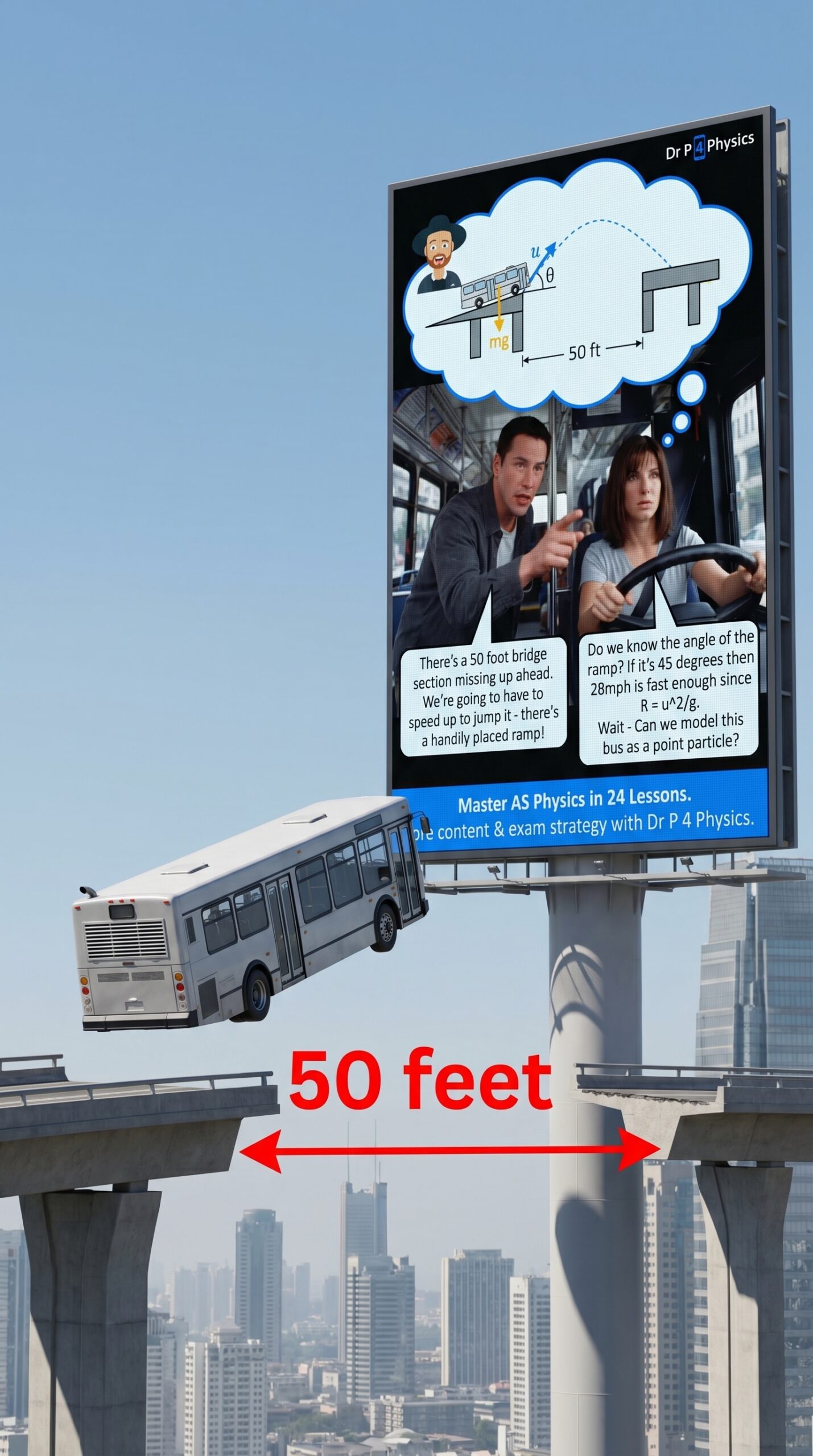
Pick a sport that isn’t Ultimate Frisbee. Chances are it will involve launching a ball, dart, javelin, hammer, discus or other object to try to hit a target. Now let’s ignore the subtleties of spin or swing due to boundary layers and the Magnus effect etc. At a first approximation you’re dealing with objects undergoing projectile motion, and this is very straightforward to solve.
The key is to uncouple the motion into horizontal and vertical components and then there will be zero acceleration horizontally and it’ll be 9.81 m/s^2 vertically downwards, but the time will link the two sets of SUVAT equations you’ll use. The mathematicians might call these parametric equations.
Newton thought about firing a cannon ball from a cannon atop a high mountain at higher and higher velocities…. the path of the cannon ball was of course a parabola…. until it wasn’t!
2.1.10 Projectile Motion
Lewis Matheson has taken the specification and turned it into a bite-size student-friendly format. I recommend printing this out and having a learning checklist at the start of your folder for each section:
OCR A – module 3 – forces and motion
AQA – module 4 – mechanics and materials
Sign up for a free account to Isaac Science and it’ll save and track your progress – working through these problems is necessary to secure that 30-40% of the paper that will be mathsy.
B4 Trajectories
Here’s a useful simulation from PhET:
I think these are fab, and hopefully your school has a subscription to them.
063: Solving problems on projectiles
193: Projectile motion
206: Key experiments 1: The ball bearing “Ski Jump”
319: Projectile Motion Calculations
See below for a quick selection of the relevant videos, you can find Lewis’ full playlist for motion here.
 Spanish
  English