
History of Science (6 lectures)
HHThe History of the History of Science Lectures:
During my PGCE at Cambridge University, I pondered the question: “What is light?” and considered how I would explain this to a class. While researching this I ended up down a rabbit hole and began answering the much more fun question: “How do we know what we think we know about what light is?” I turned my research into a short (~5 slides), chronological, powerpoint on the topic.
Then in my first sixth form I found myself teaching AQA with the Turning Points optional module. This essentially posed 3 questions: 1. How was the electron discovered? 2. What is the nature of light – wave, particle or both? 3. What happens to the laws of physics if travelling close to the speed of light (Special Relativity). Finding limited resources to cover this content in an interesting way, I thought back to my previous powerpoint and realised if I extended it I could cover all the necessary content, so I went to work on it.
Seeing the reaction of my students, and finding a new way to engage otherwise disengaged students through the craft of storytelling, I realised these shouldn’t just be classroom lessons – they should be public lectures, akin to the Royal Institution Christmas lectures, which I always loved as a child. More research followed and more threads were woven through time, including the nature of gravity, atomic theory, the scale and fate of the universe and our place within it.
In 2021, I was adding so many interesting facts and demonstrations that I had to split up my then 3 lectures into 5 so they would each fit in a 90-minute session. However, teaching OCR A at the time I realised the whole Astrophysics topic would be better explained in chronological order, so a sixth lecture was crafted.
As of 2026 I have managed to avoid teaching Particle Physics (except one year when I was the only IB teacher to a student), but my private tutees are now asking me to explain it… I have it ear-marked for a seventh lecture, but as you’ll see, each of these takes months to put together – they are my babies :O)

Inspiring Historical Narratives
Explore how key figures and discoveries shaped our understanding of the world.

Engaging, Fun, and Informative
Experience “Horrible Histories”-style storytelling, making complex ideas fun.

Flexible Options
Attend online group sessions or invite me to your school for a live experience.
What to Expect
Engaging Scientific Storytelling
Insight into Major Scientific Discoveries
Deep Understanding of Scientific Evolution
Connection to Modern Science Concepts
Placing Key Syllabus Ideas in Context
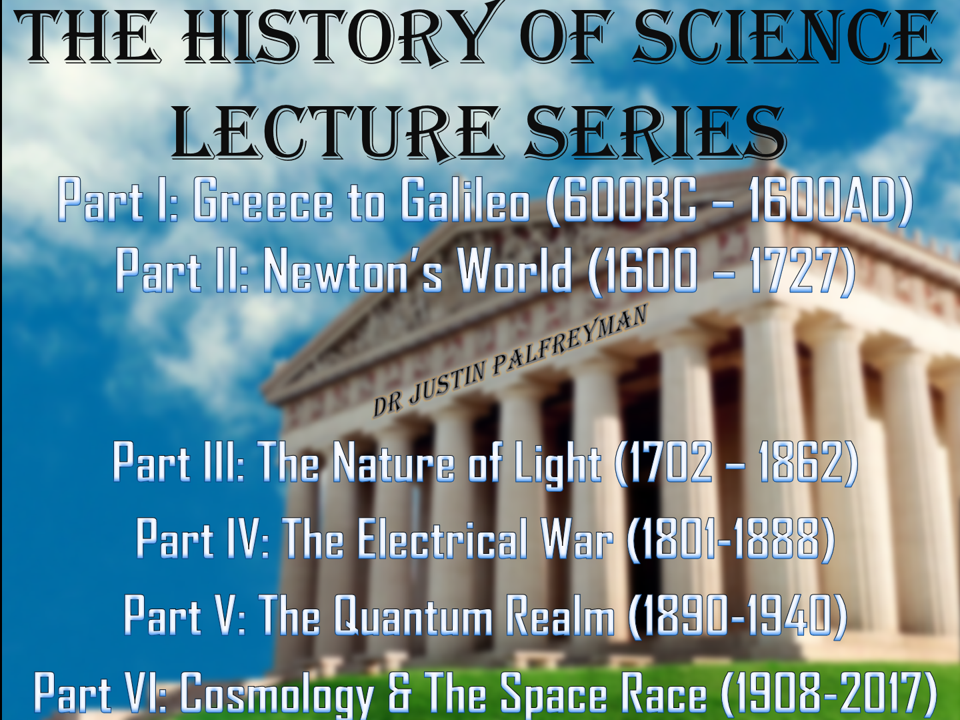
Join the History of Science Journey
This lecture series offers a unique opportunity to dive deep into the fascinating stories behind some of the greatest scientific discoveries in history. From ancient civilizations to modern breakthroughs, each lecture takes you on a journey through time, showing how science has evolved and shaped our understanding of the world.
By joining this journey, you’ll gain a greater appreciation for the scientists, experiments, and theories that have shaped the modern world. The lectures are designed to be accessible and enjoyable for all audiences, making complex scientific concepts easy to understand.
Part 1: Greece to Galileo
We begin in ancient Greece when the mysteriously behaving objects were believed to have a soul and everything was made of combinations of earth, air, fire and water. The lectures take us through the rise and fall of ancient Empires and the ebb and flow of knowledge that would see the Western world enter the dark ages, while Baghdad became the centre of enlightenment. The contributions of Arab philosophers were vital to developing the scientific method and challenging long accepted beliefs about the nature of light and the solar system.
Part II: Newton's World
We return to Europe, finally emerging from the dark ages with Galileo coming into conflict with the Church when he challenges the heliocentric model of the universe and uses the scientific method to overturn Aristotle’s 2000 year misconception about falling objects. Meanwhile, the observation of a new star in the night sky that outshines every other cannot be explained by our models of a permanent and ever-lasting universe. Later Newton will take up the mantle, falling out with almost everyone he encounters, but will leave a large legacy on Physics along the way.
Part III: The Nature of Light
We dive deeper into the nature of light – what exactly is it? Does it have a speed or travel instantaneously? How can we explain reflection and refraction? Newton thought he’d cracked it with his corpuscular theory, but experiments were showing odd behaviour that were better explained if it were a wave. Huygens, Young and Fresnel all made telling contributions, but it wouldn’t be until the speed of light could be accurately measured that we would be able to prove if Newton’s theory was incorrect.
Part IV: The Electrical War
We start in 1801 with the invention of the voltaic pile, which allows scientists to investigate the new phenomenon of electricity. The strange link with magnetism is demonstrated by Faraday and will revolutionize the shape of our lives to come. However, it will take the genius of Maxwell to explain this link and uncover the nature of light. By 1888 Tesla and Edison are ready to battle over the contract to electrify America, a dispute that would electrocute an elephant and see the invention of the electric chair, would eventually be won by the right man – although the loser would end up rich and famous.
Part V: The Quantum Realm
This brings us to the start of the 20th Century – a time when physicists thought they had essentially discovered everything there was to know. Then Rutherford noticed that atoms can change from one element to another, was alchemy back on the table? Hertz noticed something strange when ultra-violet light shone on his radio-wave experiment and Planck did some mathematical fudging to make his theory on blackbody radiation match experimental results. Enter Einstein, unable to obtain a university position, working as a patent clerk in 1904 he will publish 4 papers that each rocks the foundations of accepted science.
Part VI: Cosmology and the Space Race
With more powerful telescopes we’ll look for planets that shouldn’t be there, and discover them! Measuring distances in space is tough, but we’ll try it and find ‘nebulae’ much beyond the MilkyWay – there are more galaxies! What’s stranger is they’re moving away and accelerating, but what could be causing this behaviour? The race for dark energy and dark matter are still progressing, but who will win the race to conquer space, the Moon, Mars… ?
General Questions
FAQ
What is the History of Science Lecture Series about?
The lecture series covers the evolution of scientific thought, key discoveries, and the people behind them.
Is the lecture suitable for all students?
Yes, the lectures are designed to be engaging and informative for students of all ages and backgrounds.
Can the lectures be incorporated into a school curriculum?
Absolutely! The History of Science lectures are a great supplement to school curricula, enhancing science education.
What topics are covered?
Lectures span ancient Greece, Galileo, Newton, electricity, light, and quantum physics, highlighting pivotal scientific breakthroughs.
How long is each History of Science lecture?
Each lecture lasts approximately 90 minutes, including storytelling, explanations, and opportunities for interactive student engagement.
Are the History of Science lectures available online?
Yes, the lectures are available for online group tuition, making them accessible from anywhere.
How are the History of Science lectures delivered?
The lectures can be delivered online in group settings or as in-person events at schools.
What is the cost?
This depends whether you’d like them delivered online or in person. I can deliver each lecture for £150, but will need to factor in travel, accommodation, and set-up time if you’d like it live in your school complete with experiements – I’ll give you an equipment list for anything I don’t own myself.
Service
History of Science
The History of Science series consists of six engaging lectures, each lasting around 60 minutes. Inspired by the Royal Institution’s Christmas Lectures, these talks provide a captivating view of key scientific discoveries, from ancient civilizations to groundbreaking modern theories. Whether you’re a science enthusiast or a student looking to enhance your understanding, these lectures will offer insights into how we’ve come to understand the world around us.


Discover Science Through Stories
Get inspired by the amazing history of science, and gain insights into how the world’s greatest minds shaped our understanding of science. Explore six captivating sessions covering Greece, Galileo, Newton, electricity, light, and quantum physics.
Let’s Learn Together!
If you’ve fallen out of love with Physics; you’re struggling with the mathematical nature of the subject; you’re not sure how to revise effectively or demonstrate your knowledge when it comes to exams; you really need to secure a top grade to get into your dream university or next step. It’s time to get in touch and get you back on track!
 Spanish
  English